Monday, 7 June 2021

MOTION IN PLANE

Motion in a plane is called as motion in two dimensions e.g., projectile motion, circular motion etc. For the analysis of such motion our reference will be made of an origin and two co-ordinate axes X and Y. 

SCALAR QUANTITIES 

Those quantities which only have magnitude are known as scalar quantities.

for eg: distance , speed etc.

 VECTOR QUANTITIES

Those quantities which have magnitude as well as direction is known as vector quantities. Vector quantity is represent by arrow over the quantity in  which direction is represented by head and magnitude is represent by tail.


for eg: displacement, velocity, acceleration, force etc.

  • Magnitude of vector: It is a scalar quantity, its also called mod of a vector and its given as
 a = xi + yj + zk 

 |a| = ( x+ y2 + z2)1/2

  •  Unit Vector

A unit vector is a vector of unit magnitude and points in a particular direction. It is used to specify the direction only. Unit vector is represented by putting a cap (^) over the quantity.


  •  Equal Vectors
motion-in-a-plane-cbse-notes-for-class-11-physics-2


  •  Zero Vector( Null vector)
motion-in-a-plane-cbse-notes-for-class-11-physics-3


  •  Negative of a Vector
motion-in-a-plane-cbse-notes-for-class-11-physics-4
  • Parallel Vectors
motion-in-a-plane-cbse-notes-for-class-11-physics-5
  •  Coplanar Vectors
Vectors are said to be coplanar if they lie in the same plane or they are parallel to the same plane, otherwise they are said to be non-coplanar vectors.


  • Coinitial vectors
Those vectors which have same initial point are known as coinitial vectors.


  • Orthogonal vectors
Those vectors which are perpendicular to each other are called orthogonal vectors.


  •  Triangle Law of Vector Addition

If two vectors are represented both in magnitude and direction by the two sides of a triangle taken in the same order, then the resultant of these vectors is represented both in magnitude and direction by the third side of the triangle taken in the opposite order.
motion-in-a-plane-cbse-notes-for-class-11-physics-8
motion-in-a-plane-cbse-notes-for-class-11-physics-9 
  • Parallelogram Law of Vector Addition

If two vectors, acting simultaneously at a point, can be represented both in magnitude and direction by the two adjacent sides of a parallelogram drawn from a point, then the resultant is represented completely both in magnitude and direction by the diagonal of the parallelogram passing through that point.


If the resultant vector R subtends an angle β with vector A, then
                                    tan β = B sin θ / A + B cos θ 
Special cases: 
Case I:When the vectors are parallel to each other, i.e θ=0°,
R² = √(A² + 2ABcos0 + B²)
R² = √(A² + 2AB + B²)
R² = √(A + B)²
∴R = A + B (Maximum value of R) 
Case II:
When the vectors are perpendicular to each other, i.e θ=90°,
R² = √(A² + 2ABcos90 + B²)
∴R² = √(A² + B²)

Case III:
When the angle between the vectors (θ) is 180°. Then,
R² = √(A² + 2ABcos180 + B²)
R² = √(A² - 2AB + B²)
R² = √(A - B)²
∴ R = A - B (Minimum Value of R)


  • Polygon Law of Vector Addition
If a number of vectors are represented both in magnitude and direction by the sides of a polygon taken in the same order, then the resultant vector is represented both in magnitude and direction by the closing side of the polygon taken in the opposite order.
motion-in-a-plane-cbse-notes-for-class-11-physics-10 

Monday, 31 May 2021

Class 12 Chapter 2 Electrostatic Potential and Capacitance MCQ'S with Answers

 1. Which of the following statement is true?

(a) Electrostatic force is a conservative force.
(b) Potential at a point is the work done per unit charge in bringing a charge from any point to infinity.
(c) Electrostatic force is non-conservative
(d) Potential is the product of charge and work.

Answer  : a

2. A positively charged particle is released from rest in an uniform electric field. The electric potential energy of the charge

(a) remains a constant because the electric field is uniform.
(b) increases because the charge moves along the electric field.
(c) decreases because the charge moves along the electric field.
(d) decreases because the charge moves opposite to the electric field.

Answer : c

3. Two spherical conductors each of capacity C are charged to potential V and -V. These are then connected by means of a fine wire. The loss of energy is
(a) zero
(b) CV2
(c) CV2
(d) 2 CV2


Answer : c

4.A capacitor has some dielectric between its plates, and the capacitor is connected to a dc source. The battery is now disconnected and then the dielectric is removed, then
(a) capacitance will increase.
(b) energy stored will decrease.
(c) electric field will increase.
(d) voltage will decrease.

Answer  : c

5. Two identical capacitors are joined in parallel, charged to a potential V, separated and then connected in series, the positive plate of one is connected to the negative of the other. Which of the following is true?
(a) The charges on the free plated connected to-gether are destroyed.
(b) The potential difference between the free plates is 2V.
(c)  The energy stored in ths system increases,
(d) The potential difference remains constant.

Answer  : b

6. A parallel plate air capacitor is charged to a potential difference of V volts. After disconnecting the charging battery the distance between the plates of the capacitor is increased using an insulating handle. As a result the potential difference between the plates
(a) increases
(b) decreases
(c) does not change
(d) becomes zero

Answer  : a

7. In a parallel plate capacitor, the capacity increases if
(a)  area of the plate is increased.
(b) distance between the plates increases.
(c)area of the plate is decreased.
(d) dielectric constantly decreases.


Answer  : a

8. When air is replaced by a dielectric medium of constant K, the maximum force of attraction between two charges separated by a distance
(a) increases K times
(b) remains unchanged
(c) increases K-1 times
(d) decreases K times

Answer  : d

9. Dielectric constant for a metal is
(a) zero
(b) infinite
(c) 1
(d) 10

Answer  : b

10. A test charge is moved from lower potential point to a higher potential point. The potential energy of test charge will
(a) remain the same
(b) increase
(c) decrease
(d) become zero

Answer  : c

11. In a region of constant potential
(a) the electric field is uniform.
(b) the electric field is zero.
(c) there can be no charge inside the region.
(d) both (b) and (c) are correct.

Answer  : d

12. Equipotential surfaces
(a) are closer in regions of large electric fields compared to regions of lower electric fields.
(b) will be more crowded near sharp edges of a conductor.
(c) will always be equally spaced.
(d) both (a) and (b) are correct

Answer  : d

13. Consider a uniform electric field in the z-direction. The potential is a constant
(a) for any x for a given z
(b) for any y for a given z
(c) on the x-y plane for a given z
(d) all of these

Answer  : d


Thursday, 27 May 2021

IMPORTANCE OF PHYSICS

 Physics explains the fundamental laws of the universe and introduces important concepts that are essential for advanced study of chemistry, biology and all other branches of science. Physics is essential for understanding chemistry. Without physics students cannot understand major chemical principles.

MCQ'S FOR CLASS 11 WITH ANSWER CHAPTER 3 MOTION IN STRAIGHT LINE

1. The displacement in metres of a body varies with time t in second as y = t2 – t – 2. The displacement is zero for a positive of t equal to

(a) 1 s
(b) 2 s
(c) 3 s
(d) 4 s

 Answer: 2s
 
2. A boy starts from a point A, travels to a point B at a distance of 3 km from A and returns to A. If he takes two hours to do so, his speed is
(a) 3 km/h
(b) zero
(c) 2 km/h
(d) 1.5 km/h

Answer : 3 km/h

3. Which one of the following is the unit of velocity?
(a) kilogram
(b) metre
(c) m/s
(d) second

Answer: m/s

4.A body starts from rest and travels with uniform acceleration a to make a displacement of 6 m. If its velocity after making the displacement is 6 m/s, then its uniform acceleration a is
(a) 6 m/s²
(b) 2 m/s²
(c) 3 m/s²
(d) 4 m/s²

Answer: 3 m/s²

5. The dimensional formula for acceleration is
(a) [LT²]
(b) [L/T²]
(c) [L²T]
(d) [L²T²] 

Answer :  [L/T²]

6. A boy moves on a circular distance of radius R. Starting from a point A he moves to a point B which is on the other end of the diameter AB. The ratio of the distance travelled to the displacement made by him is
(a) ∏/2
(b) ∏
(c) 2∏
(d) 4∏

Answer :  ∏/2

7. A body starts from rest and travels for five seconds to make a displacement of 25 m if it has travelled the distance with uniform acceleration a then a is
(a) 3 m/s²
(b) 4 m/s²
(c) 2 m/s²
(d) 1 m/s²

Answer : 2 m/s²

8. A body starts from rest and travels with uniform acceleration of 2 m/s². If its velocity is v after making a displacement of 9 m, then v is
(a) 8 m/s
(b) 6 m/s
(c) 10 m/s
(d) 4 m/s

Answer :  6 m/s

9. A body starts from rest. If it travels with an acceleration of 2 m/s², its displacement at the end of 3 seconds is
(a) 9 m
(b) 12 m
(c) 16 m
(d) 10 m

Answer : 9 m

10. A boy starts from a point A, travels to a point B at a distance of 1.5 km and returns to A. If he takes one hour to do so, his average velocity is
(a) 3 km/h
(b) zero
(c) 1.5 km/h
(d) 2 km/h

Answer  : zero
 
11. A body starts from rest and travels with an acceleration of 2 m/s². After t seconds its velocity is 10 m/s . Then t is
(a) 10 s
(b) 5 s
(c) 20 s
(d) 6 s

Answer : 5 s

12. The dimensional formula for velocity is
(a) [LT]
(b) [LT-1]
(c) [L2T]
(d) [L-1T]

Answer : [LT-1]

13. The dimensional formula for speed is
(a)  [LT-1]
(b) [LT]
(c) [L-1T-1]
(d) [L-1T]

Answer :   [LT-1]

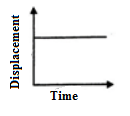
14.  Which of the following is not possible for a body in uniform motion?
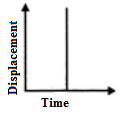
         
  1. Displacement-Time Graph
  2. Displacement-Time Graph
  3.  Both (a) & (b)
  4.  None of the above

Answer : both a and b

15. A man leaves home for a cycle ride and comes back home after an half-an-hour ride covering a distance of one km. What is the average velocity of the ride?
  1. 10 kms-1
  2. ½ kms-1
  3. 2 kms-1
  4. Zero

Answer:  Zero


16. Which of the following remains constant if a body travels with constant acceleration?

  1. Time
  2. Velocity
  3. Displacement
  4. None of the above

Answer: None of the above


17. What does the displacement of the particle shown in the graph indicate?


  1. It indicates a constant velocity
  2. It indicates a constant acceleration
  3. It indicates that the particle starts with a constant velocity and is accelerated
  4. It indicates that the motion is retarded and the particle stops

Answer: It indicates that the motion is retarded and the particle stop


18. If distance covered by a particle is zero, what can be its displacement?

  a. it may or may not be zero

  b. it cannot be zero

  c. it is negative

  d. it must be zero


Answer :  it must be zero


Wednesday, 26 May 2021

CAPACITOR AND CAPACITANCE CLASS 12

 Capacitors 


capacitor is a device having two metal plates seperated by small distance, these metals have opposite charge. Some dielectric is also introduced between these plates.

  • The total charge of a capacitor is zero while the conductors have charge Q and –Q.
  • A single conductor can be considered as capacitor with other conductor at infinity.
  • Electric field in the region between the conductors is proportional to the charge Q.
  • Capacitors is also called condensers.
Types of capacitors
i) Parellel plate capacitor
ii) Spherical capacitor
iii) Cylindrical capacitor


 Capacitance
Capacitance of a conductor is a measure of ability of the conductor to store charge.
when a charge is given to a conductor, it is raised to a certain potential. As charge on the conductor increases its potential rises
i.e         charge     potential
                  Q     ∝ V
                   Q    =  CV
Where c is capacity of capacitance.
S.I unit of capacitance is farad (F).

Capacitanceis denoted by, C = Q/V. It depends on
  • Geometrical configuration (shape, size, separation) of the system of two conductors.
  • Nature of insulator/dielectric separating
  • Charge on the capacitor leaks away due to reduction in the insulating power of the intervening medium. This happens due to higher potential difference causing strong electric fields.
  • Maximum electric field which a dielectric medium can withstand without breakdown and prevent leaking of charge is called dielectric strength. Air dielectric strength is 3 x 10Vm-1.


MOTION IN PLANE

Motion  in a plane is called as motion in two dimensions e.g., projectile motion, circular motion etc. For the analysis of such motion our r...